For the beginning of this topic on solution to quadratic equations, click here.
free kii ads
Friday, April 15, 2011
Thursday, April 7, 2011
Solving Quadratic Equations
Quadratic equations are equations of the form,
An example of a quadratic equation is
Another example is
Quadratic equations can be solved in 3 ways. They are
1. Solution by factorization
2. Solution by completing the square method
3. Solution by the quadratic equation formula.
One thing to note is that before solving any quadratic equation, a test for the availability of factors should be carried out.
For the quadratic equation,
, the test of the availability of factors is given by
When test 1 gives a perfect square, the quadratic equation can be factorized as a product of 2 simple factors. But if test 1 does not give a perfect square, it means the factorization of the given quadratic equation cannot give 2 simple factors.
For instance, in the case of the previous example
The test of the availability of factors = test 1
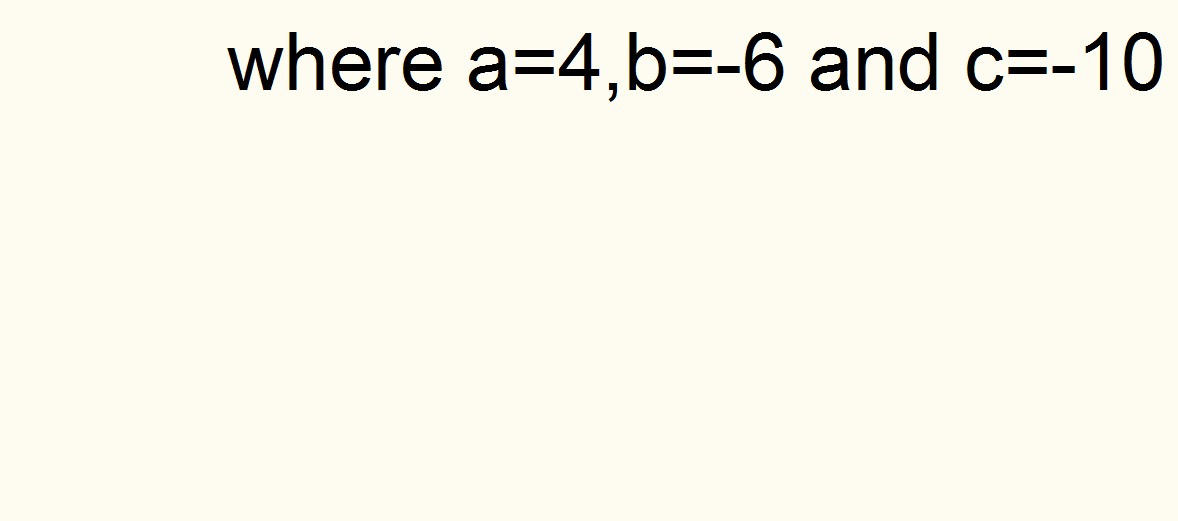
Where a =1, b=11 and c=28
= 9
9 is a perfect square because 9 is equal to 3 squared that is the square of 3 = 9.
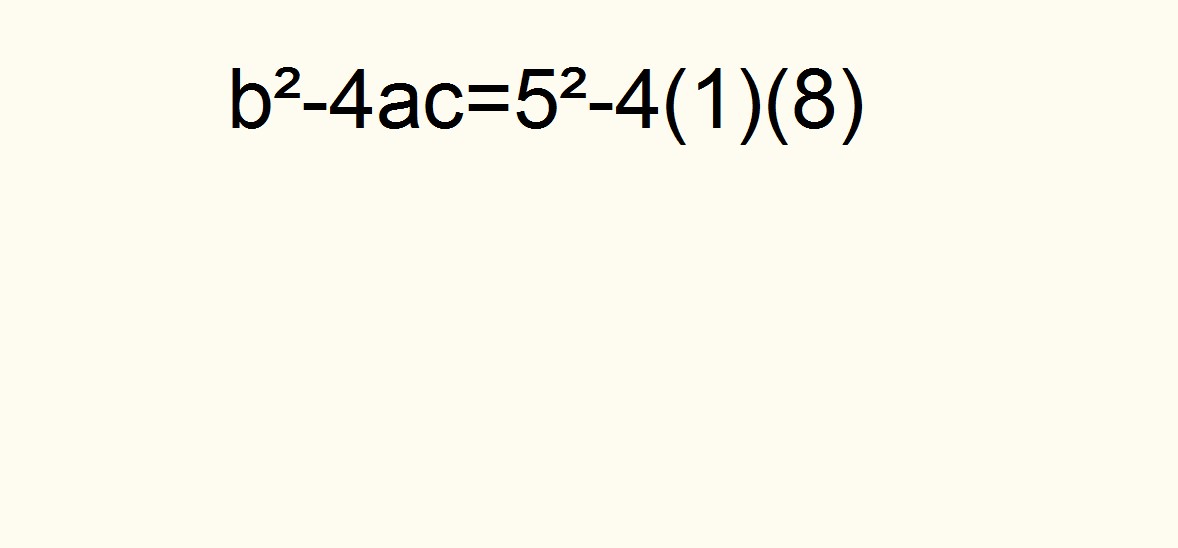
Testing, we have
Now take another equation
, Testing for the availability of factors,we have
Now -7 is not a perfect square, so the factorization of
will not give a perfect square. You can confirm this by working it out.
Tuesday, May 25, 2010
Solving a binomial Using The Pascal's Triangle
The Pascal s triangle is to some extent useful in expanding a binomial. Before I go on, let me explain what a binomial is. A binomial could be defined as a mathematical expression of two terms which usually involves addition and subtraction. Examples are (y-1), (x+a)^2, (x-3)^3.
The Pascal s triangle makes the expansion of binomials with high powers easier and faster. The Pascal s triangle for a binomial with increasing power is the pattern of coefficient of the binomial as its power increases from a lower value to a higher value. It is best explained using an example. Lets take a binomial (x+1) increasing in power from (x+1)^1 to (x+1)^2 to (x+1)^3 on and on like that till we reach (x+1)^6 we have a pattern like the one below.
Binomial coefficient
(x+1)^1 1 1
(x+1)^2 1 2 1
(x+1)^3 1 3 3 1
(x+1)^4 1 4 6 4 1
(x+1)^5 1 5 10 10 5 1
(x+1)^6 1 6 15 20 15 6 1.
This pattern of coefficients is what mathematicians commonly refer to as the Pascal s triangle. It is the same for all binomials. Pascal s triangle can be derived or was derived by a french philosopher called Pascal. For how it can be derived see Pascal s triangle.
Now let us give an example. Expand (y-1)^3.
Solution.
First of all we look at the power to which the binomial is raised which is 3.
Next we go to the Pascal's triangle and see the coefficients that correspond to a binomial raised to the power of 3 which are 1 3 3 1.
So (y-1)^3=1+3+3+1.
Next we identify the first and second terms which are y and -1 respectively.
Futhermore, we then multiply the first and second terms to the coefficients but know that the powers of the first term y decrease from the power of the binmial to 0 going from left to right while that of -1 increase from 0 to that of the binomial. See Pascal's triangle and binomial.
So (y-1)^3= 1(y)^3(-1)^0+3(y)^2(-1)^1+3(y)^1(-1)^2+1(y)^0(-1)^3
(y-1)^3= y^3-3y^2+3y-1
The Pascal s triangle makes the expansion of binomials with high powers easier and faster. The Pascal s triangle for a binomial with increasing power is the pattern of coefficient of the binomial as its power increases from a lower value to a higher value. It is best explained using an example. Lets take a binomial (x+1) increasing in power from (x+1)^1 to (x+1)^2 to (x+1)^3 on and on like that till we reach (x+1)^6 we have a pattern like the one below.
Binomial coefficient
(x+1)^1 1 1
(x+1)^2 1 2 1
(x+1)^3 1 3 3 1
(x+1)^4 1 4 6 4 1
(x+1)^5 1 5 10 10 5 1
(x+1)^6 1 6 15 20 15 6 1.
This pattern of coefficients is what mathematicians commonly refer to as the Pascal s triangle. It is the same for all binomials. Pascal s triangle can be derived or was derived by a french philosopher called Pascal. For how it can be derived see Pascal s triangle.
Now let us give an example. Expand (y-1)^3.
Solution.
First of all we look at the power to which the binomial is raised which is 3.
Next we go to the Pascal's triangle and see the coefficients that correspond to a binomial raised to the power of 3 which are 1 3 3 1.
So (y-1)^3=1+3+3+1.
Next we identify the first and second terms which are y and -1 respectively.
Futhermore, we then multiply the first and second terms to the coefficients but know that the powers of the first term y decrease from the power of the binmial to 0 going from left to right while that of -1 increase from 0 to that of the binomial. See Pascal's triangle and binomial.
So (y-1)^3= 1(y)^3(-1)^0+3(y)^2(-1)^1+3(y)^1(-1)^2+1(y)^0(-1)^3
(y-1)^3= y^3-3y^2+3y-1
Thursday, May 6, 2010
Solving Simultaneous Equation Through Substitution Method
The substitution method is one of the ways through which one can solve simultaneous equations with two variables. The best way to explain it is through a worked example.
Solve the simultaneous equations using substitution method, x+2y= 3, 2x-4y= 8.
Step 1: Name the equations
x+2y = 3..................(1.)
2x-4y = 8..................(2.)
Step 2: From (1.), make x the subject of the eqn since eqn (1.) is simpler than eqn (2.).
So from (1.),
x+2y = 3
x= 3-2y.
Step 3: Now substitute for x in (2.).
So from (2.),
2x-4y = 8 but x=3-2y
so 2x-4y = 8 becomes
2(3-2y)-4y= 8
6-4y-4y = 8
6-8y = 8
-8y = 8-6
-8y = 2
y = 2/-8
y = -1/4.
Step 4: To find x, substitute for y in (1.).
So from (1.),
x+2y = 3 but y= -1/4
so x+2y = 3 becomes
x+2(-1/4)= 3
x-1/2 = 3
x = 3+1/2
x = (6+1)/2
x = 7/2
So x = 7/2, y = -1/4.
For more info on this check http://adf.ly/2IzE

Bookmark & Share
Solve the simultaneous equations using substitution method, x+2y= 3, 2x-4y= 8.
Step 1: Name the equations
x+2y = 3..................(1.)
2x-4y = 8..................(2.)
Step 2: From (1.), make x the subject of the eqn since eqn (1.) is simpler than eqn (2.).
So from (1.),
x+2y = 3
x= 3-2y.
Step 3: Now substitute for x in (2.).
So from (2.),
2x-4y = 8 but x=3-2y
so 2x-4y = 8 becomes
2(3-2y)-4y= 8
6-4y-4y = 8
6-8y = 8
-8y = 8-6
-8y = 2
y = 2/-8
y = -1/4.
Step 4: To find x, substitute for y in (1.).
So from (1.),
x+2y = 3 but y= -1/4
so x+2y = 3 becomes
x+2(-1/4)= 3
x-1/2 = 3
x = 3+1/2
x = (6+1)/2
x = 7/2
So x = 7/2, y = -1/4.
For more info on this check http://adf.ly/2IzE
Bookmark & Share
Tuesday, May 4, 2010
Simultaneous Equations Using Elimination Method
Introduction
The elimination method is one way to solve simultaneous equation. It is very useful really if the coeeficients of the equation are greater than one you. Let's proceed to see how this method can be used.
Solve the following simultaneous equation, 3a-4b= 1, 2a+3b= 5
(1.) 3a-4b=0, 2a+3b= 5
Solution
Name the equations
3a-4b= 1 (1)
2a+3b= 5 (2)
Then multiply eqn (1) by 2 and eqn (2) by 3
(3a-4b= 1)*2 and
(2a+3b= 5)*3 to give
6a-8b= 2 (3)
6a+9b=15 (4)
Subtract eqn (3) from (4)
6a+9b= 15
-
6a-8b= 2
17b= 13
b= 13/17
Substitute for b in (1).
So from (1)
3a-4b= 1
and since b= 13/17
3a-4(13/17)=1
3a-4.13/17= 1
3a-52/17= 1
3a= 1+52/17
3a= 17/1+52/17
3a= (17+52)/17
3a= 69/17
a= 69/17*1/3
a= 23/17
For more info on simultaneous equation you can download an e-book from this link http://sharecash.org/download.php?file=6275

Bookmark & Share
The elimination method is one way to solve simultaneous equation. It is very useful really if the coeeficients of the equation are greater than one you. Let's proceed to see how this method can be used.
Solve the following simultaneous equation, 3a-4b= 1, 2a+3b= 5
(1.) 3a-4b=0, 2a+3b= 5
Solution
Name the equations
3a-4b= 1 (1)
2a+3b= 5 (2)
Then multiply eqn (1) by 2 and eqn (2) by 3
(3a-4b= 1)*2 and
(2a+3b= 5)*3 to give
6a-8b= 2 (3)
6a+9b=15 (4)
Subtract eqn (3) from (4)
6a+9b= 15
-
6a-8b= 2
17b= 13
b= 13/17
Substitute for b in (1).
So from (1)
3a-4b= 1
and since b= 13/17
3a-4(13/17)=1
3a-4.13/17= 1
3a-52/17= 1
3a= 1+52/17
3a= 17/1+52/17
3a= (17+52)/17
3a= 69/17
a= 69/17*1/3
a= 23/17
For more info on simultaneous equation you can download an e-book from this link http://sharecash.org/download.php?file=6275
Bookmark & Share
Labels:
ELIMINATION METHOD,
SIMULTANEOUS EQUATION,
SOLVE
Subscribe to:
Posts (Atom)